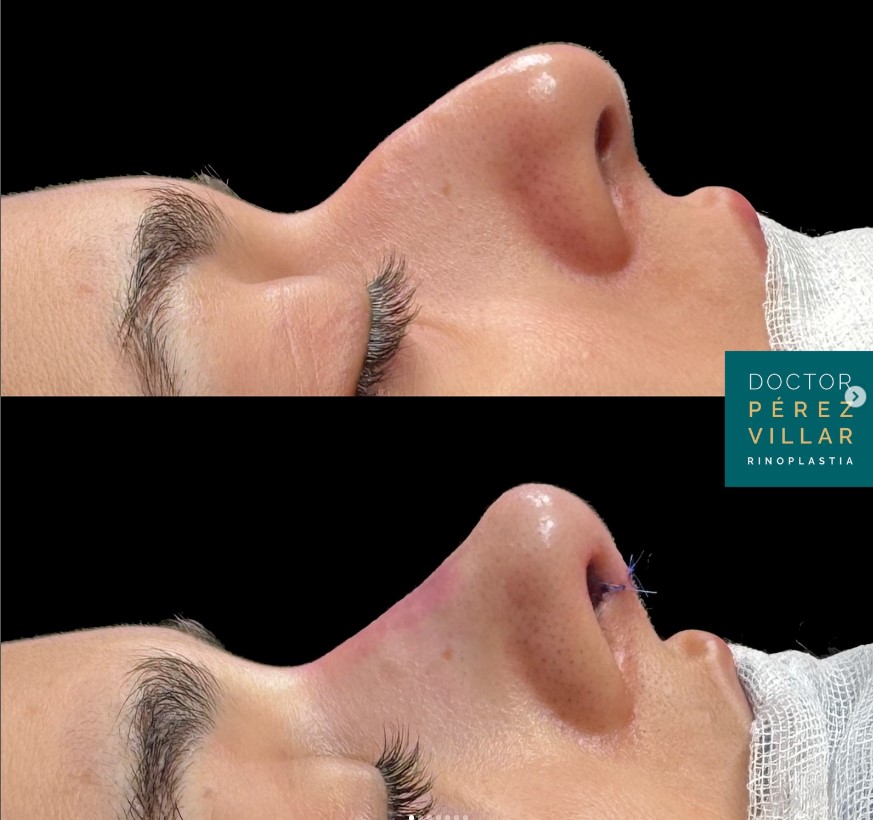
In the field of aesthetic and functional nasal surgery, each patient presents unique characteristics that require a personalized approach. Today we share a recent case of female rhinoseptoplasty performed by Dr. Pérez Villar, where ultrasonic rhinoplasty was combined with functional correction to improve both facial harmony and breathing capacity.
Initial Situation: A Complex Case
The patient consulted with several aesthetic and functional concerns related to her nose. She presented a low radix, which made the beginning of the nasal dorsum appear under-projected. In addition, she had a mixed hump (bony and cartilaginous) and a wide nasal bone, giving the nose a stronger, less refined appearance.
In the tip area, there was a drooping, bulbous, and undefined nasal tip, a feature that added heaviness to the lower third of the nose and disrupted overall balance with her facial proportions.
Functionally, the patient reported breathing difficulties, which were confirmed during clinical evaluation. Deviations in the septum and turbinate hypertrophy were detected, both contributing to impaired airflow.
This scenario required a comprehensive surgical approach that addressed both aesthetics and functionality, with the goal of achieving a more harmonious nose and improved breathing.
Surgical Technique: Ultrasonic Rhinoplasty and Septoplasty
Dr. Pérez Villar chose an ultrasonic rhinoplasty, an advanced technique that allows precise bone reshaping with minimal trauma to surrounding tissues. Unlike traditional instruments, the piezoelectric device used in ultrasonic rhinoplasty acts only on bone structures without damaging soft tissue, reducing swelling and promoting faster recovery.
In this particular case, ultrasonic rhinoplasty allowed the surgeon to:
- Correct the mixed hump and refine the nasal profile.
- Narrow and reshape the wide nasal bone, creating a more proportional dorsum.
- Elevate and refine the nasal tip, transforming it from bulbous and drooping to more defined and supported.
- Design a slightly curved dorsum with a subtle supratip break that naturally separates the dorsum from the tip.
Additionally, a septoplasty was performed to correct the deviated septum, together with a turbinectomy to reduce the size of the turbinates. Both procedures were crucial in restoring proper airflow and ensuring that the result was both aesthetic and functional.
Aesthetic and Functional Outcome
The outcome of the surgery shows a more balanced and natural nose. The profile is now harmonious thanks to an elegant dorsum and a defined tip, with just the right amount of curvature to enhance femininity. The supratip break adds refinement, subtly distinguishing the tip from the dorsum and preventing an artificial look.
From the frontal view, the narrowing of the nasal bone contributes to a slimmer contour that complements the patient’s facial proportions. The tip, once drooping and bulbous, now appears more defined and stable, striking the right balance between naturalness and sophistication.
Functionally, the patient now enjoys significantly improved breathing, the result of the septoplasty and turbinectomy. This case highlights the importance of rhinoseptoplasty as a comprehensive procedure that improves not only appearance but also quality of life.
The Value of Personalized Planning
Every rhinoplasty case is unique and requires careful evaluation of the patient’s anatomy and expectations. The success of this surgery lies in combining an advanced technique, such as ultrasonic surgery, with a holistic surgical plan that addresses both form and function.
The extensive experience of Dr. Pérez Villar in complex rhinoplasty procedures was essential to achieve a result that not only enhances facial harmony but also improves the patient’s overall well-being.
Conclusion
This real case of female rhinoseptoplasty demonstrates how ultrasonic rhinoplasty, combined with functional procedures such as septoplasty and turbinectomy, can achieve natural aesthetic results while simultaneously resolving breathing issues.
The patient, who initially presented with a low radix, a mixed hump, wide nasal bones, and a drooping, bulbous tip, obtained a more harmonious and functional nose. This outcome illustrates how a well-planned rhinoseptoplasty can go beyond cosmetic improvement to deliver lasting functional benefits and enhance quality of life.