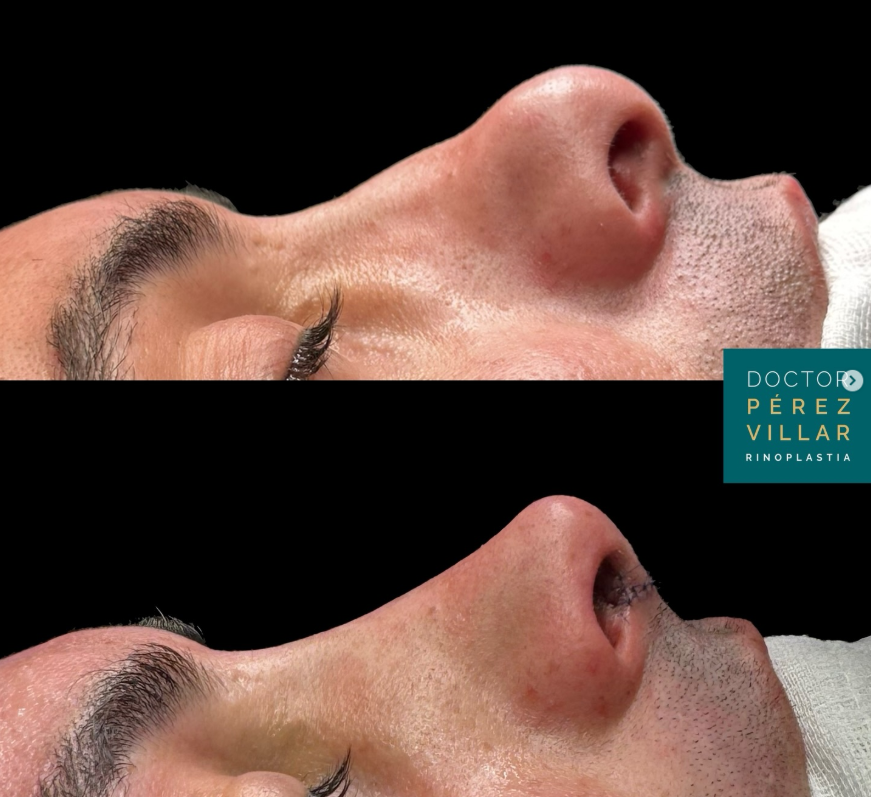
There are cases in which nasal surgery is not primarily aesthetic, but medically necessary. This is an example of a functional rhinoseptoplasty with rib graft, a procedure indicated in patients with severe nasal deformities, structural damage, and significant breathing impairment.
When the nose has lost structural support, presents major deviation, or has septal fractures, the main goal is not just to improve appearance, but to reconstruct the nasal framework and restore proper breathing. Understanding this type of surgery is essential to set realistic expectations.
Functional rhinoseptoplasty with rib graft combines septal correction with full nasal reconstruction using cartilage taken from the patient’s own rib. This approach is used when there is insufficient native structure to support and shape the nose.
Initial patient condition
The patient presented a highly complex nasal deformity. The nose was completely deviated to the left, while the right side showed collapse and lack of structural support.
The nasal septum was fractured both along the dorsum and in the caudal portion, leading to instability of the nasal tip. This caused the septum to contact the right nasal ala, resulting in complete airway obstruction.
Additionally, there was tip ptosis and a significant loss of structural integrity, affecting both function and facial harmony.
What severe nasal deformity involves
Severe nasal deformities affect both appearance and quality of life.
In this case, structural deviation, airway collapse, septal fracture, and weakened support coexisted, leading to breathing difficulties and facial asymmetry.
These situations require a reconstructive approach rather than minor adjustments.
Why rib graft is used
In complex cases, septal or ear cartilage is often insufficient.
Rib cartilage provides both volume and strength, making it ideal for rebuilding the nasal framework.
Because it is the patient’s own tissue, it integrates well and reduces rejection risk.
Surgical goals
The goals are both functional and structural.
The surgery aims to restore nasal support, correct deviation, improve breathing, stabilize the nasal tip, and enhance facial harmony.
It is not about creating a different nose, but about reconstructing it in a way that fits the patient’s anatomy.
Surgical process
The procedure begins with a comprehensive medical evaluation.
A personalized surgical plan is then developed. During surgery, rib cartilage is harvested and shaped to rebuild the nasal structures.
The septum is corrected, the nose is repositioned, and structural support is restored.
Postoperative course
Recovery is gradual and requires medical follow-up.
Swelling is expected, especially in reconstructive cases. Breathing typically improves progressively.
Final results take time as the nose stabilizes.
Real case
In this case, a full nasal reconstruction using rib cartilage was performed, restoring support, improving breathing, and correcting the deformity.
These procedures highlight the importance of individualized treatment.
Thank you to our patient for allowing us to share this case.